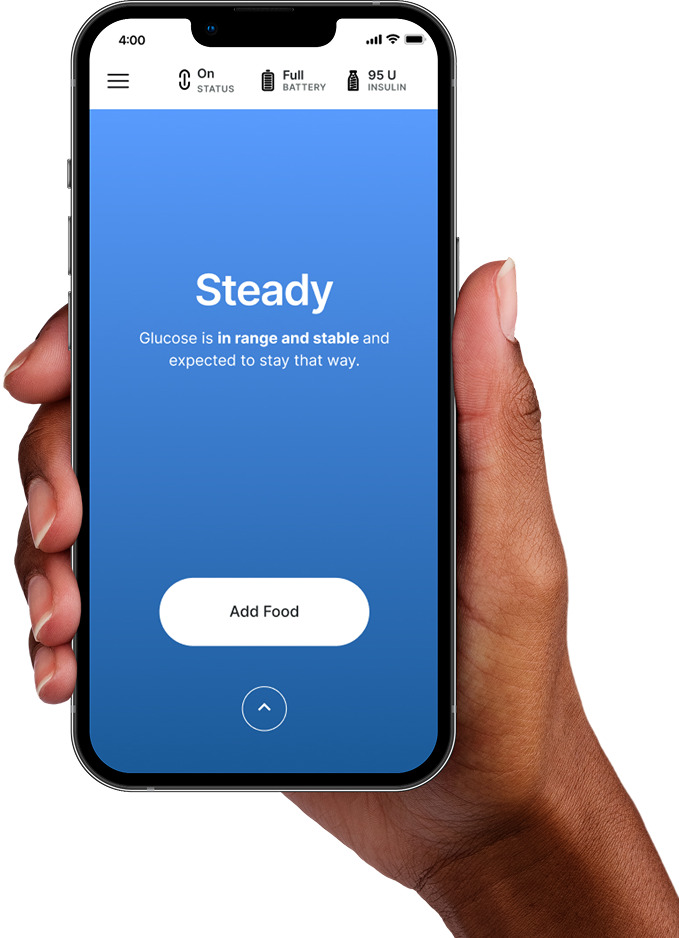
The Brief
Tandem had a hypothesis: automate insulin pump settings, and people with diabetes could spend less time managing their disease.
Before committing engineering resources to that direction, they needed to know if it was real. Who needed this? What were they actually struggling with? The cost of getting it wrong, in time, money, and delayed patient impact, was significant.
Was settings automation the solution to a real problem, or a solution in search of one?
The Work
Phase 1: Finding the Real Problem
We started with discovery. Interviews with people with diabetes and with the clinicians who train them. Quick, rough prototypes to make ideas tangible enough to test. We held our hypothesis loosely and followed the evidence.
The insight came quickly, and it was clear: people with diabetes weren't thinking about pump settings at all. They were thinking about whether the pump was visible under clothes. Whether they could swim with it. Whether they could go to a wedding.
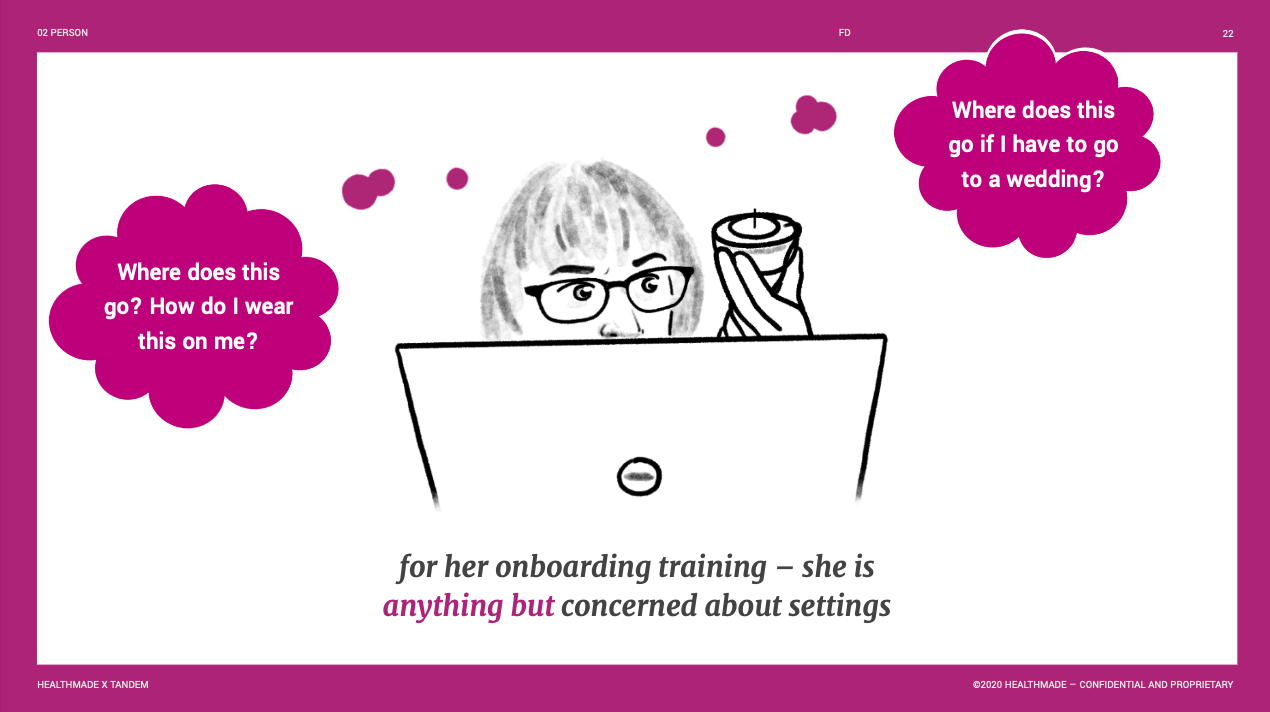
Settings were a clinician problem. The burden fell on diabetes educators: spending hours training new patients on pump setup, then chasing optimal settings over months of follow-up calls. That's where automation could have real impact.
Phase 2 & 3: From Pivot to Product
With a clear target user, the design question changed. Not "how do we automate settings for patients?" but "how much automation is right for clinicians, and how much control do they need to keep?"
We mapped a spectrum of approaches, from algorithm-assisted suggestions with full clinician visibility to fully background automation with none. We prototyped each model and tested with clinicians and diabetes educators.
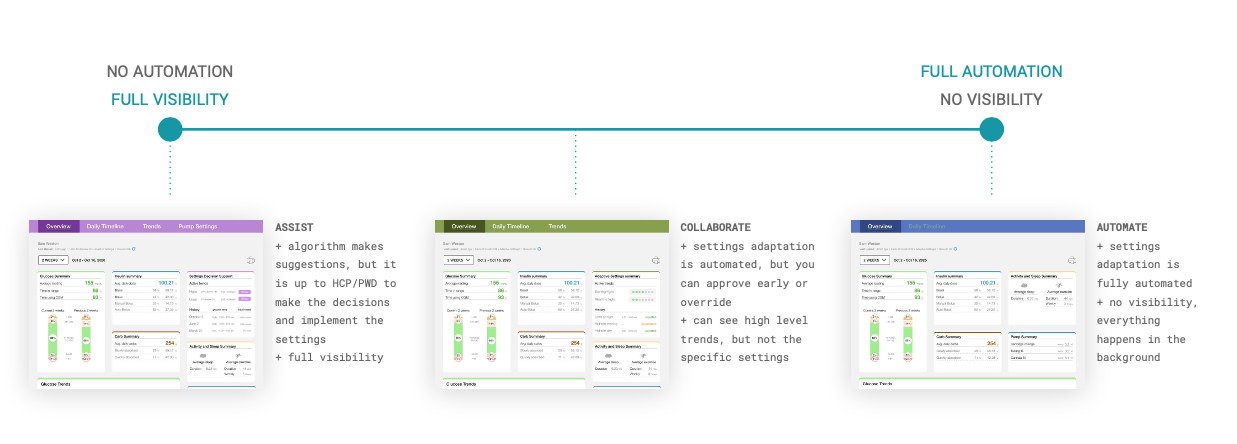
We found the middle ground. Enough automation to reduce the burden, enough transparency to maintain clinical trust. Phase 2 validated the concept. Phase 3 translated it into a complete UX concept and design direction: detailed, realistic, ready for engineering handoff.
The Outcome
We delivered a validated product direction with engineering-ready UX specifications. That pivot, from consumer feature to clinical tool, saved Tandem from committing significant resources to the wrong problem. And the research that led there was exactly the kind of evidence they needed to move forward with confidence.
Right Problem
Research redirected investment from a consumer hypothesis to a validated clinical opportunity, before a line of engineering was written
De-Risked
Rapid, realistic prototypes tested core assumptions across three phases without significant engineering investment
Ready to Build
Delivered a complete UX concept, design system, and implementation specifications for engineering handoff
My Role
I led the project from initial discovery through final delivery, working across data science, behavioral science, and product design. I designed the research approach, built and ran rapid prototyping sessions, and shaped the pivot when evidence pointed somewhere unexpected. The work that matters most to me about this project: we started at the very beginning, held our concepts loosely, and let the research lead. That's how you prove the research is good.
The Team: Sara Krugman (Project & Design Lead) · Jing Yu (Lead Designer) · Rochelle Ardesher (Communications Designer)